
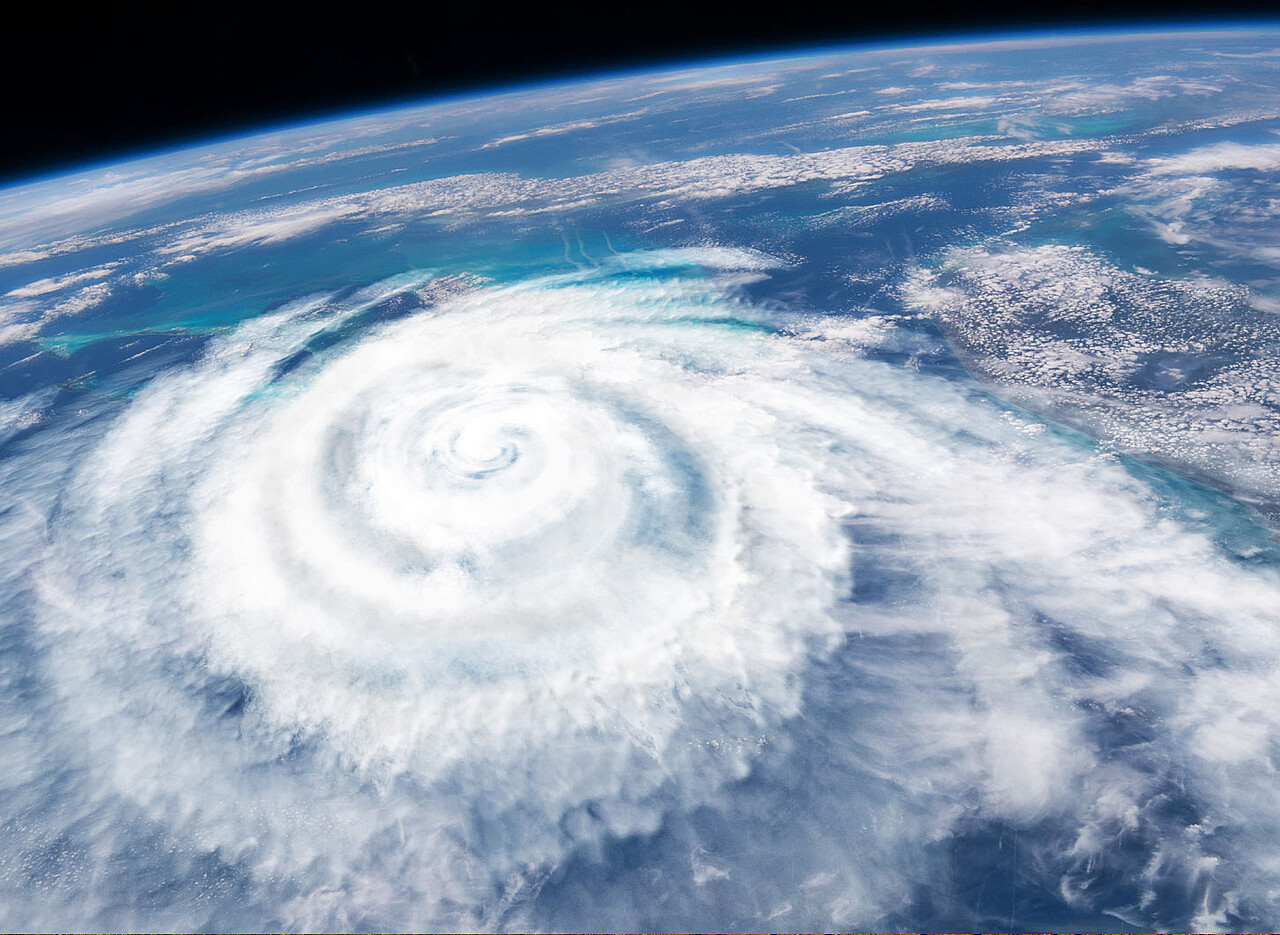
Calculating the damage caused by natural disasters
Dr Raschke, my mathematical understanding is not sufficient for me to imagine how I could calculate the effects of something as complex as a storm, for example. How do you do that?
Dr Mathias Raschke: There are basically four different approaches. What they all have in common is that they use existing data and make statistical and stochastic deductions from it. One possibility is to draw conclusions about the future from existing loss data. But this has its limits. If you want to calculate the damage consequences for a storm that statistically only occurs every 100 or 200 years, this model based on ten years of damage observation will not help you very much because the estimation uncertainty is too great.
Other models try to take this into account by modifying historical wind fields and estimating the corresponding losses or their total. This is essentially based on the judgement of experts. Still other modelling approaches depict artificial storms in the future on the basis of climate simulations. But does a model that was created to simulate climate change over long periods of time provide reliable results for natural disasters? After all, these are very short-term events.
And how do you proceed?
Dr Mathias Raschke: My approach is based on investigating the properties and correlations of the data provided by many measuring stations. This can be explained well using the example of a winter storm. The storm is not only measured at one measuring station, but at many. This can be used to map a wind field, i.e. to show the maximum speed at which the storm hit where. These local wind speeds correspond to local return periods, which can be averaged. This return period of a storm correlates with the return period of accumulation damage, which can be observed for the wind field but can also be estimated (as if). The mean return period can be scaled together with the local return periods to events that statistically only occur every 100 years or 200 years.
Finally, their relationship can be represented in a "mean return period to accumulation damage" coordinate system.
In other words, I get a precise view of the future severity of an exceptional storm and the resulting damage in a region?
Dr Mathias Raschke: With this approach, we can estimate how high an accumulation loss would be if a storm occurs next that statistically only occurs every 100 or even 200 years.
That would be the current situation, so to speak - looking into the future. But the parameters also change as a result of building development or changes in the landscape. How can this be mapped?
Dr Mathias Raschke: Time series must stand up to comparison, which means that such changes must of course be taken into account. My model is based on data from the past 20 years. Due to the brevity of this time series, climate change should hardly be noticeable in it. If the wind speeds at a measuring station change significantly within a short period of time, for example, this may be due to the fact that buildings have changed or the station itself has been moved to a different location. The meteorologists usually point this out so that this factor can be included in the calculations or at least mentioned. Irrespective of this, my model could be adapted very quickly and easily if it is known how the local return periods change with climate change. The models established in the insurance industry do not offer this possibility. And since they do not explicitly take spatial correlations into account, the question arises as to whether they always deliver appropriate results.
What advantages do these calculations ultimately bring for the policyholder?
Dr Mathias Raschke: We now have the expertise to determine the risk of natural disasters for geographical regions. This certainly does not have a direct effect on the individual risk, because the statistical inaccuracy would be too great. But at Ecclesia Re, one of the things we look at is the nature of the accumulation risk of a larger portfolio that a reinsurer should include in its books. And through this channel, the findings naturally also have an influence on the question of how the individual can obtain the best possible insurance cover at the best possible prices. Because if the reinsurer knows the risk relatively precisely, it can also calculate its premium requirements more accurately. The risk of error is smaller.
Can this method also be used to calculate how often severe storm events can be expected in the future?
Dr Mathias Raschke: My aim was to determine how likely accumulation losses are for today's conditions. In principle, however, the method can also provide the basis for analysing trends in storm frequency. However, the statements must be reliable, i.e. the data basis must be sufficiently large. This is difficult for a comparatively small region like Germany.
We were recently hit by a flooding disaster that is considered to be the most severe and damaging natural disaster in German history to date. Can your calculation method also make statements about accumulation losses for such events?
Dr Mathias Raschke: In principle, this is possible - also for other types of natural disasters. But once again, it depends on the data basis. Gauging stations on rivers are rarer than wind measuring stations. In addition, a river system is a comparatively small-scale constellation, and the water level alone is not the only decisive parameter. Flow velocities, structural obstacles on and in the river ... there are a number of additional variables. This also increases the estimation error. Nevertheless, such stochastic scaling can provide information about possible accumulation damage and thus at least provide an indication of the risks for which disaster prevention resources should be made available.
The questions were asked by Thorsten Engelhardt from Corporate Communications.
Dr Mathias Raschke (54) has been part of the team at reinsurance broker Ecclesia Re since January 2021 and calculates the impact of natural catastrophes, among other things. A civil engineer by training, he completed his doctorate with a calculation model for the effects of earthquake scenarios on expected losses. His professional and scientific career has included positions at ETH Zurich and the reinsurer R+V Re.